
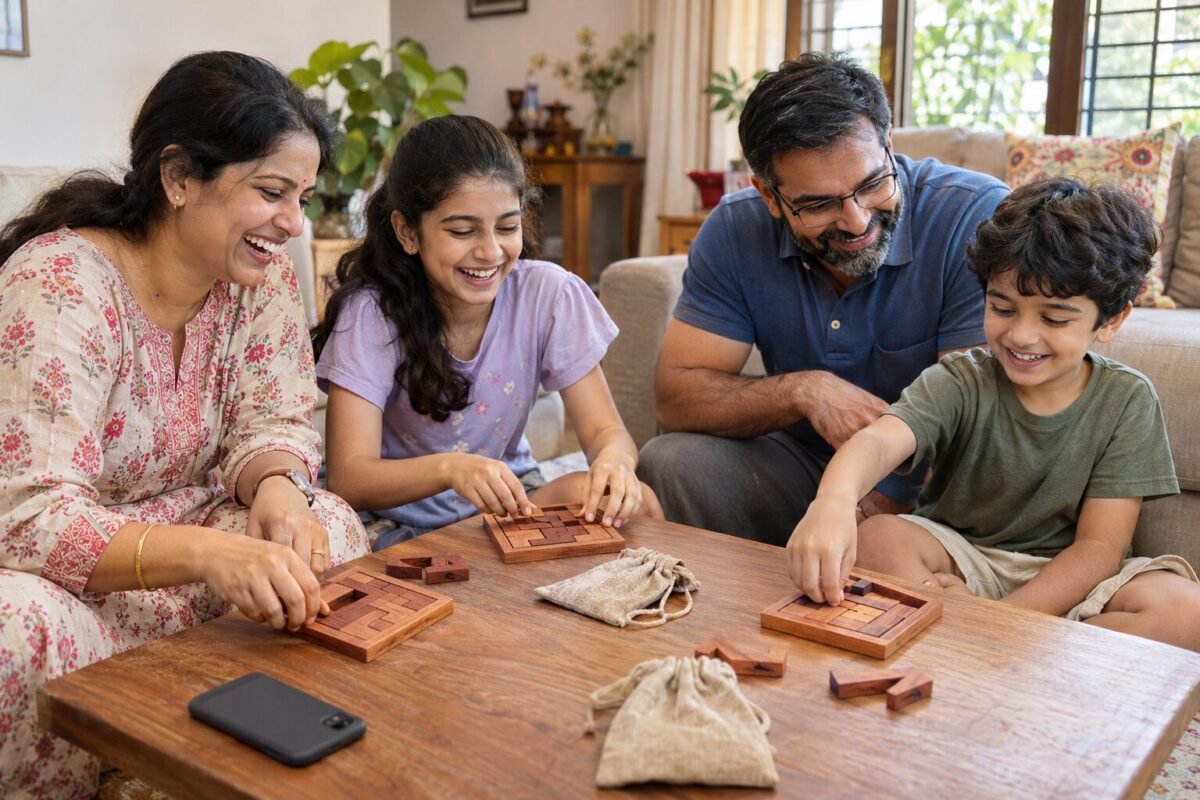
Every parent knows the moment. You say “five more minutes,” the tablet stays on for twenty, and the evening ends in a small argument nobody wanted. Taking the screen away is the easy part. The hard part is handing over something that actually holds a child’s attention.
That is where wooden brain teaser puzzles earn their place. A good one fits in your palm, has no battery, no ads and no autoplay, and it still manages to keep an eight-year-old quiet and frowning in concentration for half an hour. Kids don’t treat it as homework. They treat it as a dare: can I do this?
In this guide we’ll look at what brain teasers actually do for a growing mind, walk through ten wooden puzzles worth trying (from the easy ones to the ones that will test you as well), and share a few simple routines that help puzzles replace some screen time without turning it into a battle.
What Makes Wooden Brain Teaser Puzzles Different
A jigsaw puzzle shows you the answer on the box. A brain teaser doesn’t. You get a frame, a handful of oddly shaped pieces and one simple rule, such as “fit everything inside the square,” and the rest is up to you.
That small difference changes how a child thinks. With a jigsaw, they match colors and edges to a picture. With a brain teaser, they have to imagine: if I turn this piece, will it fit there? What happens to the gap I leave behind? They try something, it fails, and they try again with a slightly better idea. That loop of guessing, testing and adjusting is the heart of problem-solving.
Wood adds something too. The pieces have weight. They click against each other and slide on the board. Children pick them up, turn them over and feel the shape in their fingers before they see where it goes. For many kids, especially younger ones, thinking with their hands comes before thinking in their heads.
And practically speaking, wooden puzzles last. They don’t crack when dropped, they don’t run out of charge on a long train journey, and they look just as good after a year of play.
The Skills Kids Build With Brain Teasers
It is easy to make big claims about “brain development,” so let’s stay with what is reasonably well supported.
Spatial thinking
Spatial skill is the ability to picture shapes in your mind and move them around: rotating, flipping and fitting them together. It sounds like a narrow skill, but it shows up everywhere, from reading a map to understanding geometry to packing a suitcase.
Researchers at the University of Chicago followed 53 families at home for two years and observed how often young children played with puzzles. They found that children who played with puzzles between ages 2 and 4 later showed better spatial skills when tested at around four and a half. The link held even after the researchers accounted for family income and parent education. The study shows an association rather than proof that puzzles cause the improvement, and the researchers said as much. Still, it is a good reason to keep puzzles in the house.
Focus and patience
A brain teaser rarely gives in on the first try. Children learn, without anyone lecturing them, that sticking with a problem is how it gets solved. That patience is a habit, and like any habit it gets stronger with practice.
Planning ahead
Harder puzzles reward kids who think two steps ahead. Place the big awkward piece first and the small ones have room; do it the other way round and you get stuck. Over time, children start to plan before they move, which is exactly the habit we want them to bring to schoolwork.
Handling frustration
This one is underrated. A puzzle that won’t come out is a small, safe kind of frustration. Children learn to take a break, come back calmer and see the problem fresh. Parents often notice this more than anything else.
Hands-on, unhurried play
The World Health Organization recommends that children aged one to four spend no more than an hour a day on screens, and less is better. It also encourages quiet, non-screen activities shared with a caregiver, such as reading, storytelling and puzzles. Older children don’t have a strict WHO limit, but the idea carries over: some of their quiet time should be spent making and solving, not just watching.
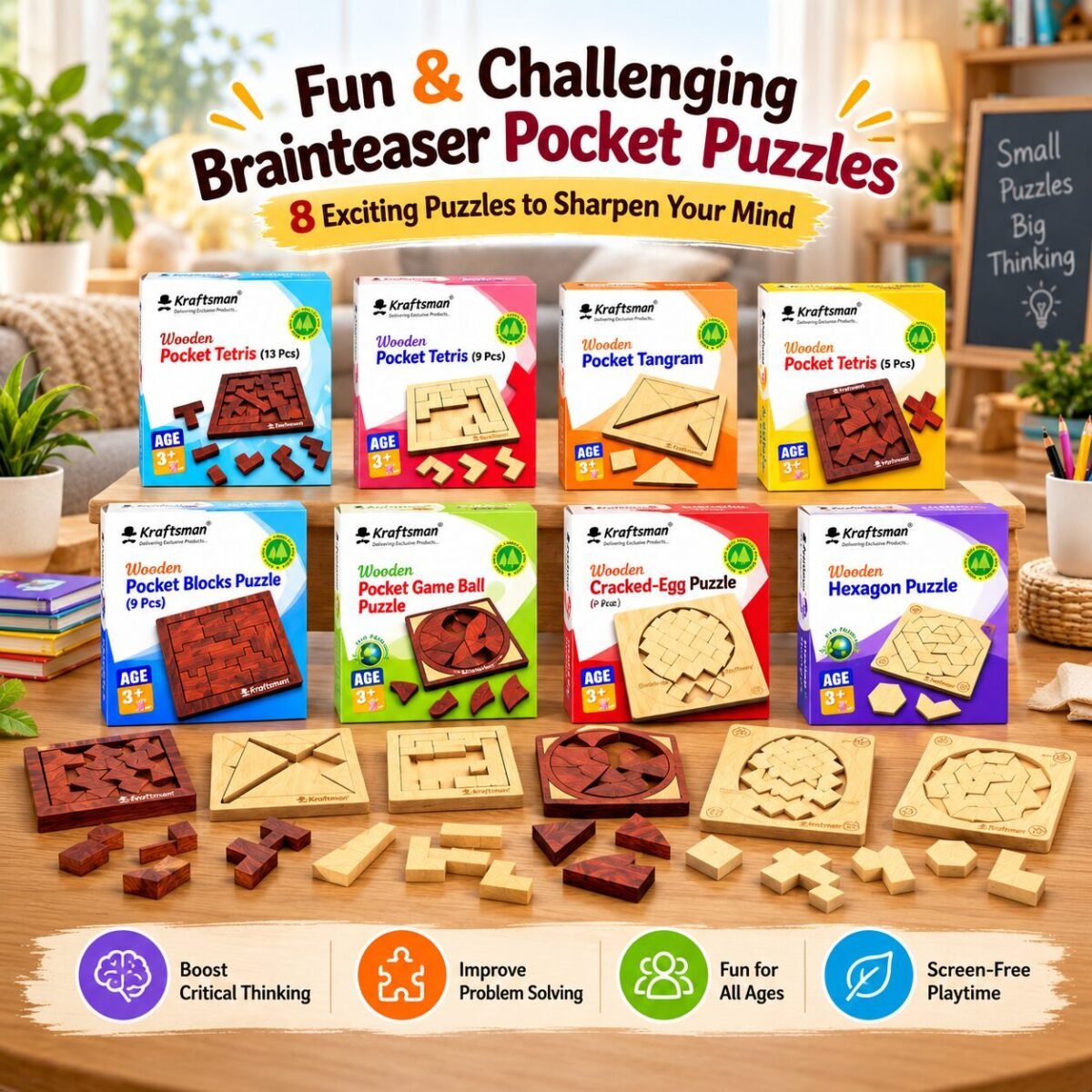
10 Wooden Brain Teaser Puzzles to Try at Home
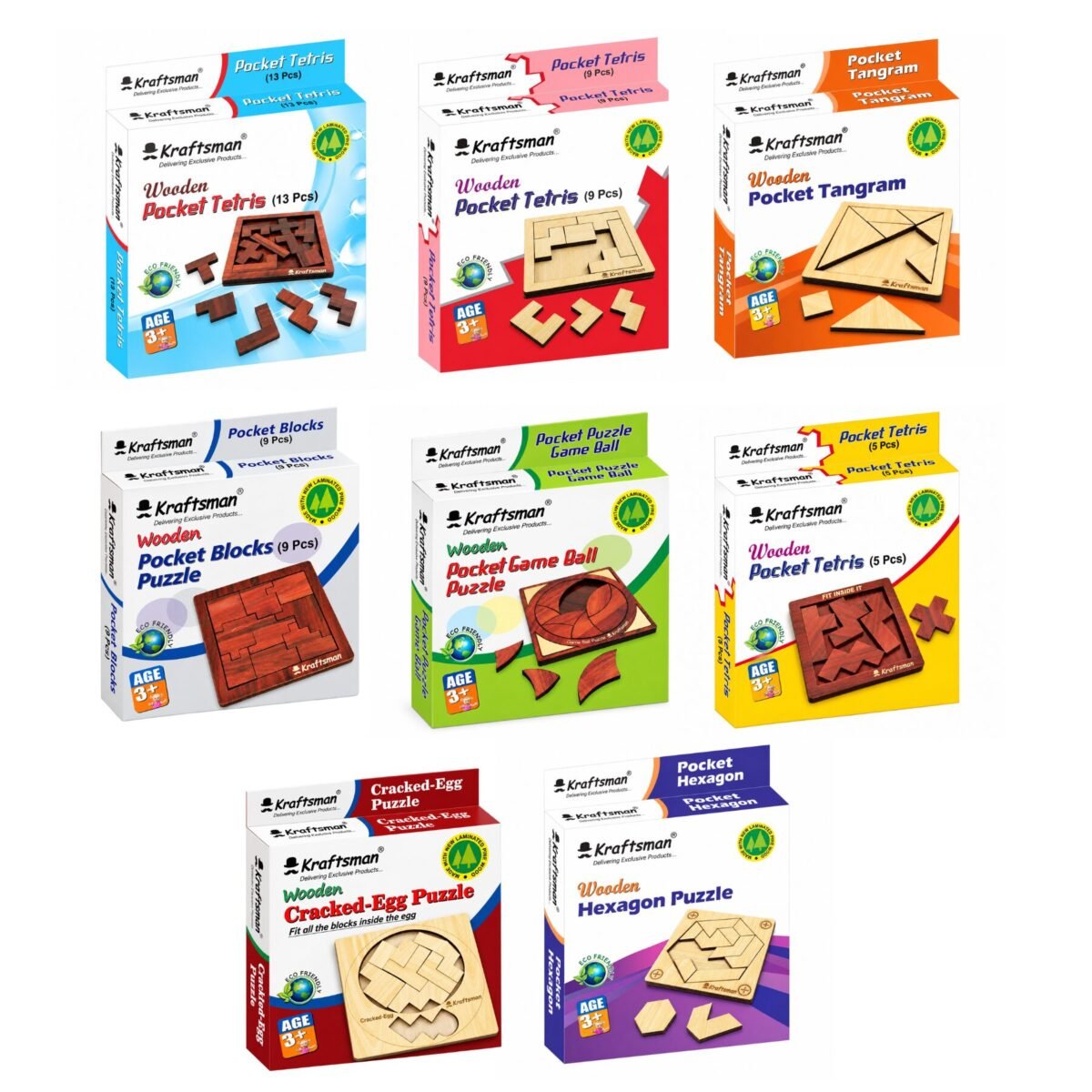
The ten puzzles below are all Kraftsman designs made in India. We’ve listed them roughly from easiest to hardest. The pocket puzzles share the same compact size, about 10 × 10 cm and 100 g, and each one comes with a travel pouch. The packaging lists them for ages 3 and up; younger children enjoy fitting the pieces with a little help, while the full challenge suits older kids and adults.
1. Tetris Puzzle (5 Pieces): the perfect first brain teaser
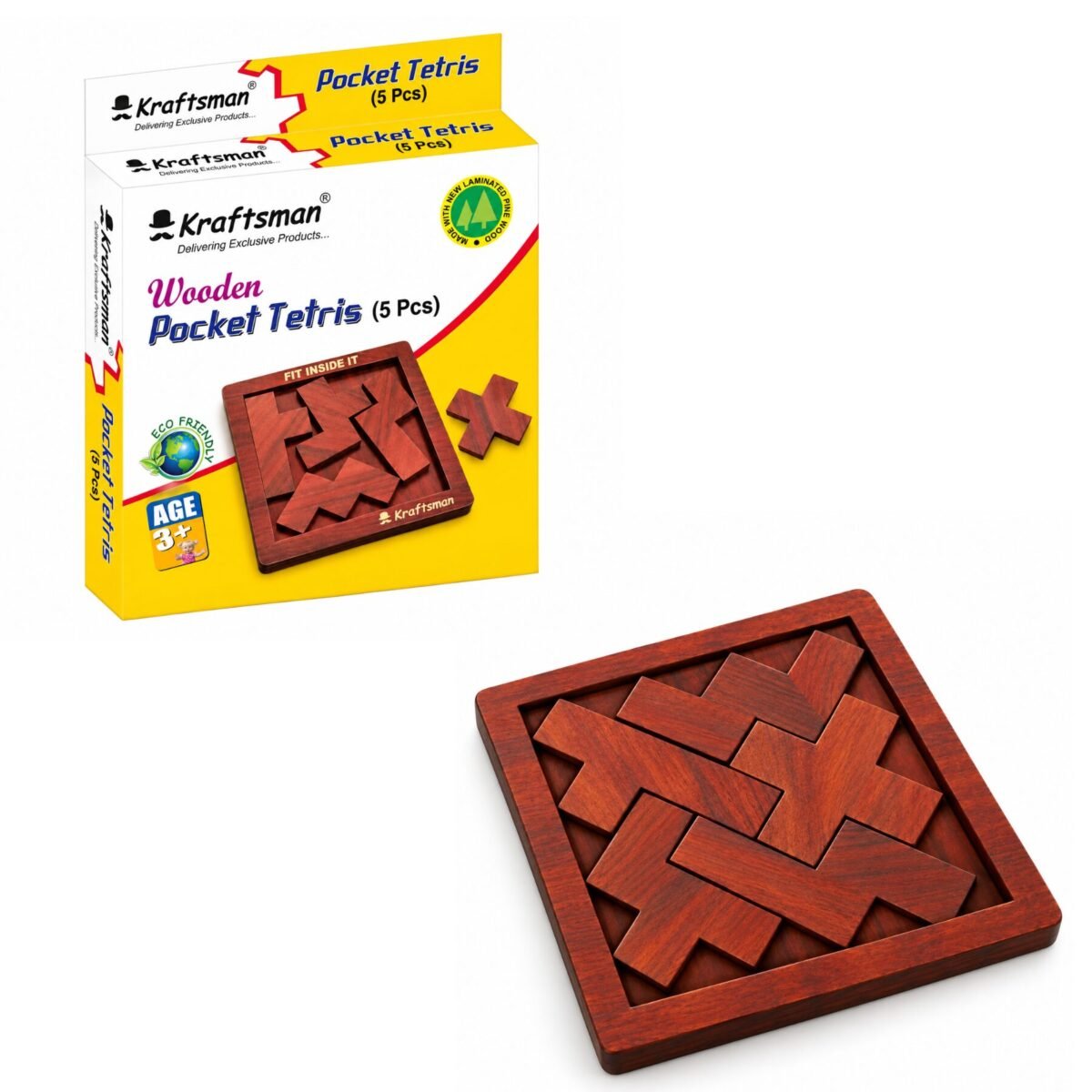
If your child has never tried a brain teaser, start here. The Tetris Puzzle (5 Pcs) asks them to fit five wooden pieces inside a square frame. Five pieces is enough to make them think, but not so many that they give up. It is a great confidence builder, and the moment it clicks, most kids will tip the pieces out and do it again just to prove it wasn’t luck.
Best for: first-timers and younger children. Builds: shape recognition and early spatial reasoning.
2. Pocket Tangram: the classic shape-maker
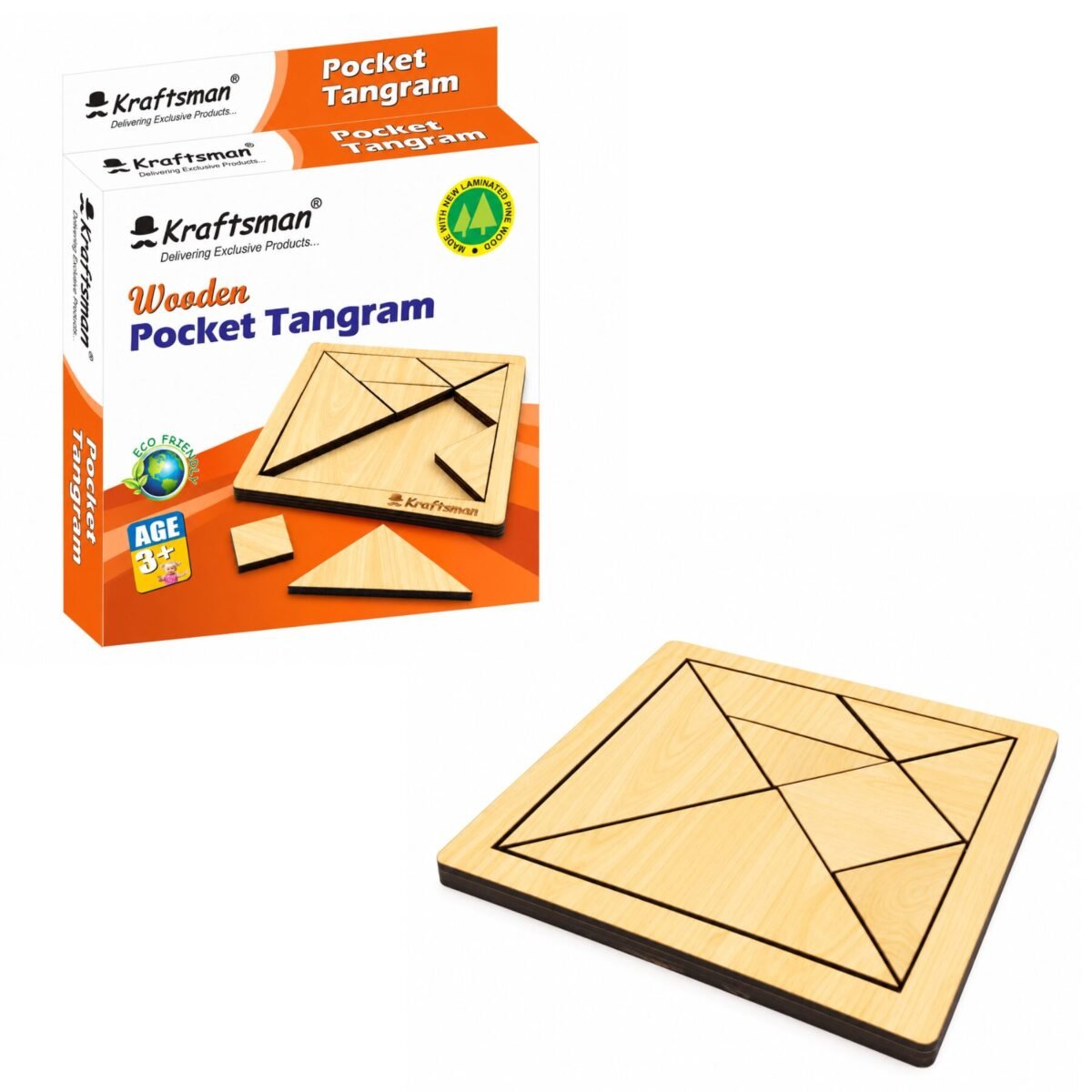
Tangrams have been around for a long time. The idea is believed to have come from China, and the puzzle became hugely popular in Europe and America in the 1800s. A classic tangram uses a small set of flat geometric shapes that can be arranged into a square, or into hundreds of figures: animals, people, boats and houses.
The Pocket Tangram Puzzle is lovely because it has no single right answer. Once your child can rebuild the square, challenge them to make a cat, a rocket or a running man. Search “tangram shapes” together and pick a few silhouettes to copy.
Best for: creative kids who like open-ended play. Builds: pattern recognition and visual imagination.
3. Pocket Tetris Puzzle (9 Pieces): a step up
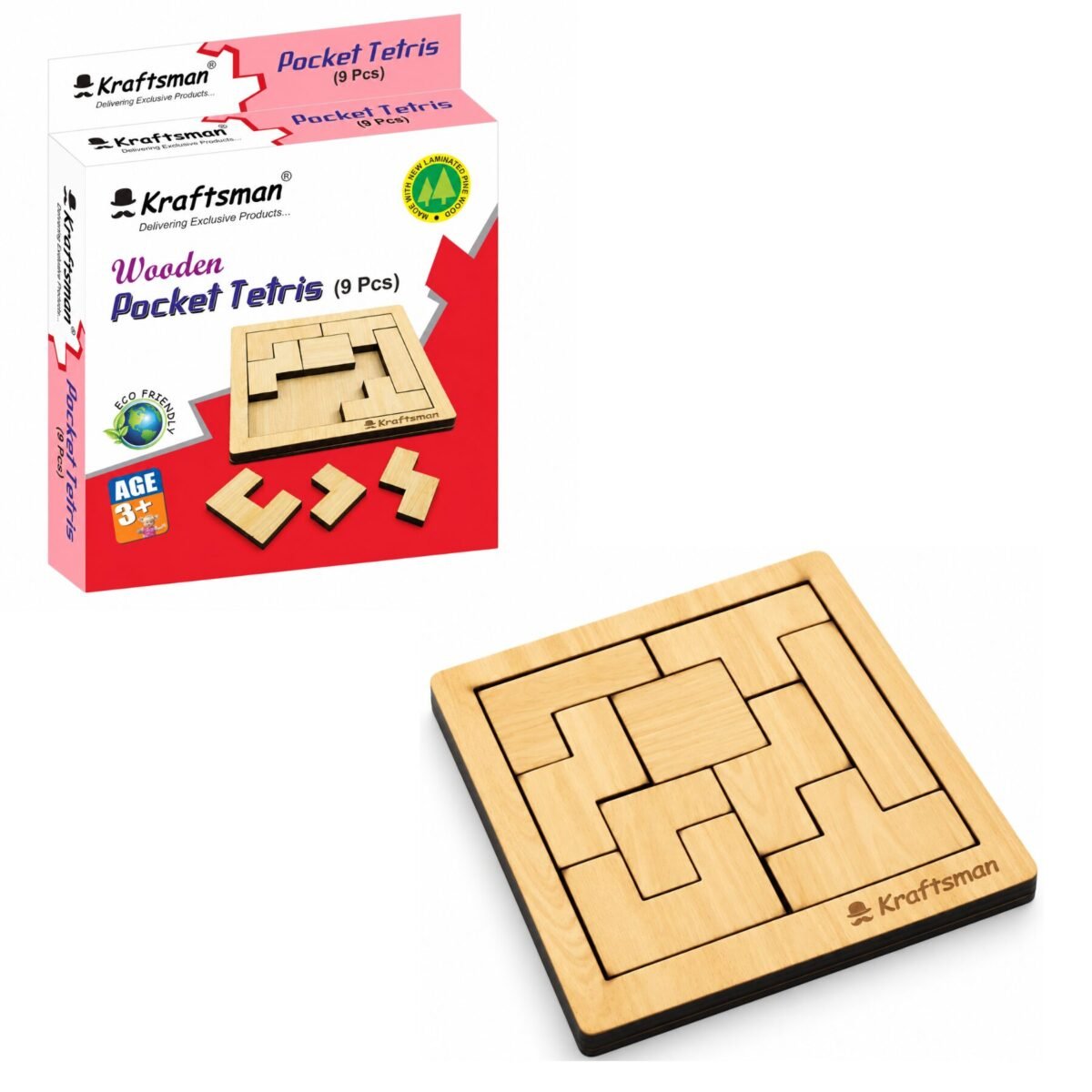
The Pocket Tetris Puzzle (9 Pcs) is the natural next level. Nine pieces mean more combinations, and kids quickly discover that the obvious first move isn’t always the right one. This is where they start learning to undo and rethink.
Best for: children who’ve mastered the 5-piece version. Builds: trial-and-error thinking and persistence.
4. Pocket Blocks Puzzle (9 Pieces): thicker, chunkier thinking
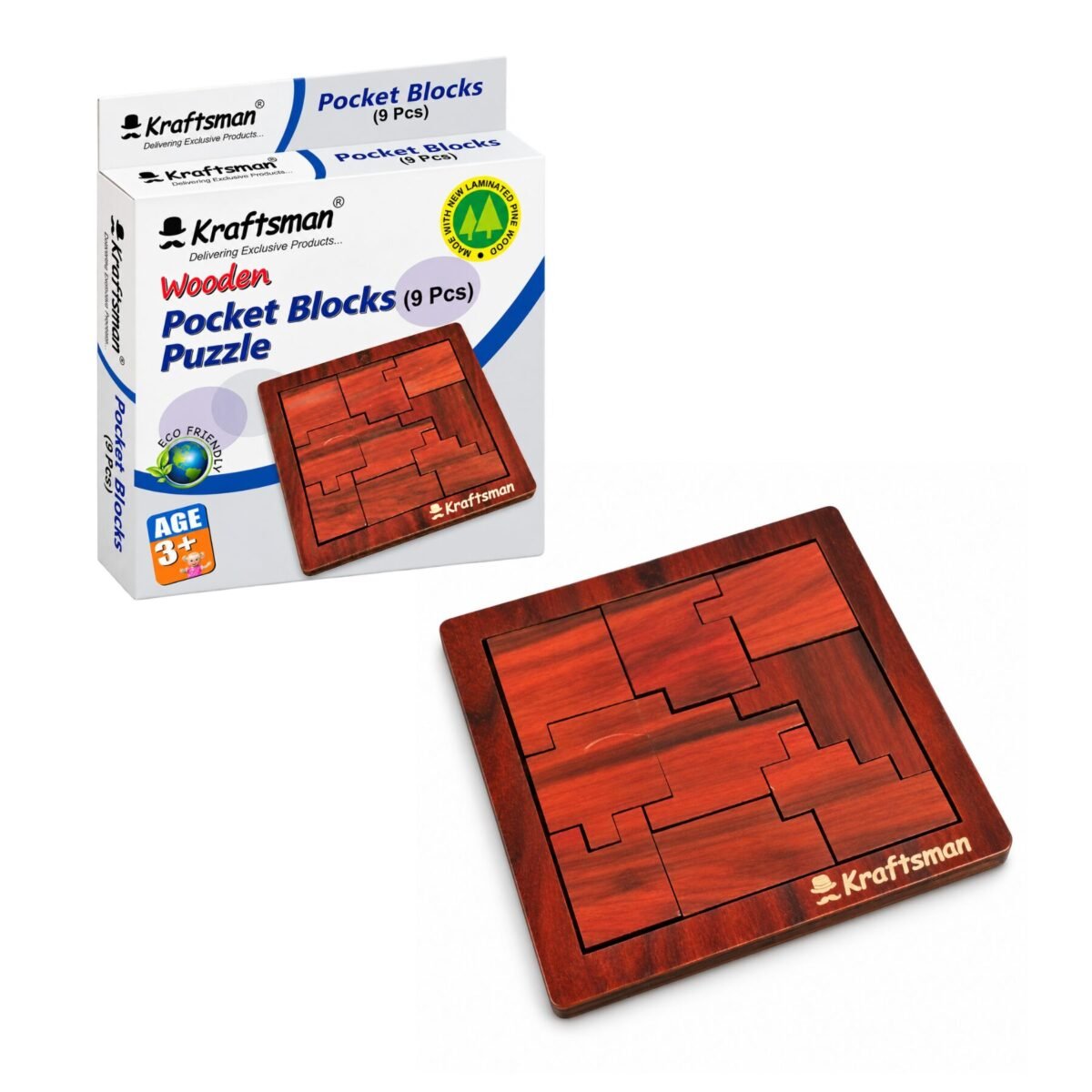
The Pocket Blocks Puzzle uses nine uniquely shaped wooden blocks that all have to fit in the square frame. The chunky pieces are satisfying to hold, and the different shapes from the tetris sets make it feel like a fresh challenge rather than a repeat.
Best for: kids who enjoy building and stacking. Builds: shape awareness and independent play.
5. Hexagon Puzzle: geometry you can hold
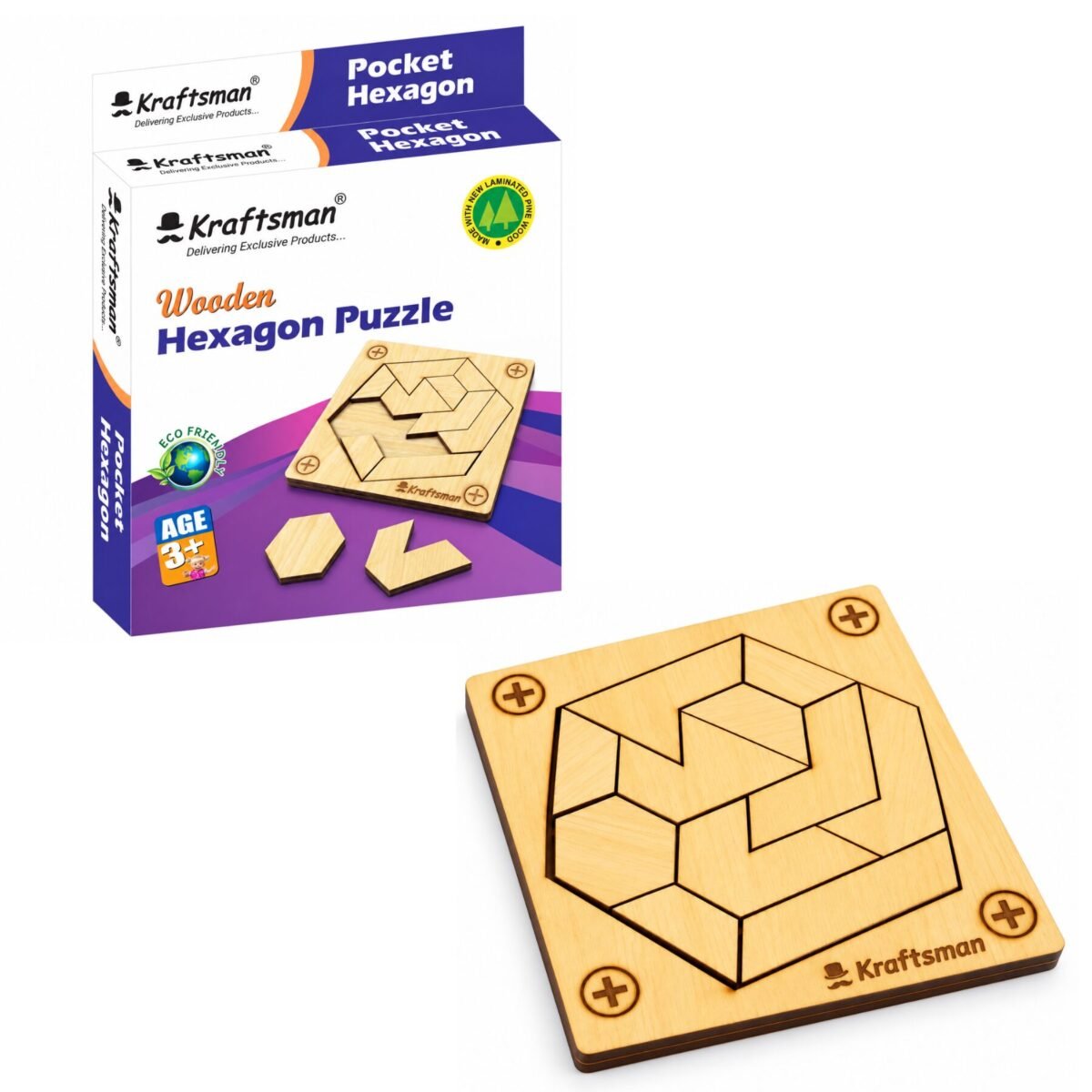
Most puzzles are square. The Hexagon Puzzle is not, and that alone throws people off. The angles don’t behave the way our eyes expect, so kids have to look more carefully at how edges meet. It’s a quiet introduction to geometry without a single worksheet.
Best for: observant kids who like a twist. Builds: visual observation and understanding of angles.
6. Game Ball Puzzle: the one that looks easy
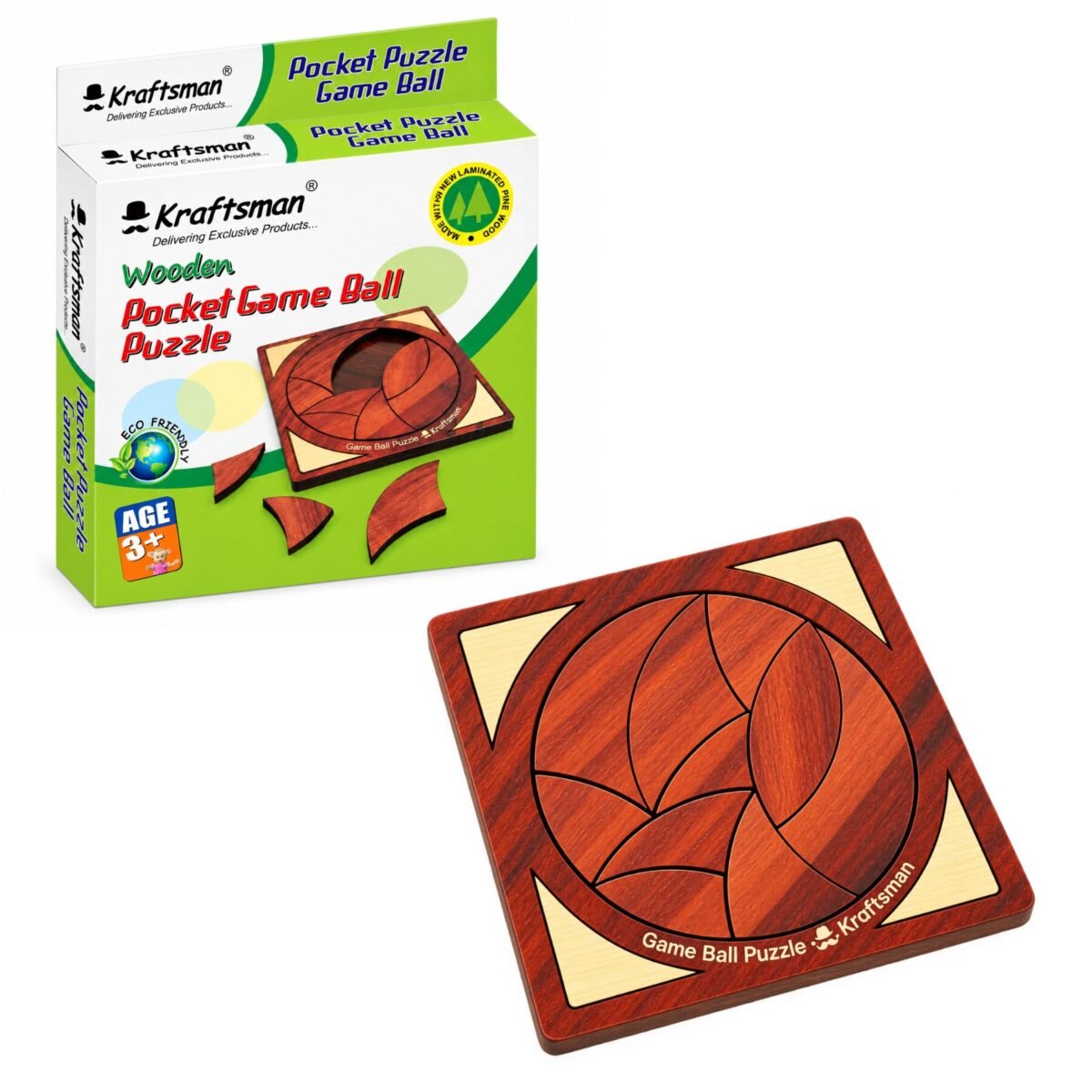
The Game Ball Puzzle asks you to arrange the wooden pieces to complete a ball-inspired design. It looks simple in the picture. It isn’t. Curves are harder to match than straight edges, so this one tends to humble adults as much as children, which makes it a good puzzle for parents and kids to race each other on.
Best for: ages 8 and up, and competitive families. Builds: patience and pattern matching.
7. Cracked Egg Puzzle: a clever little shape
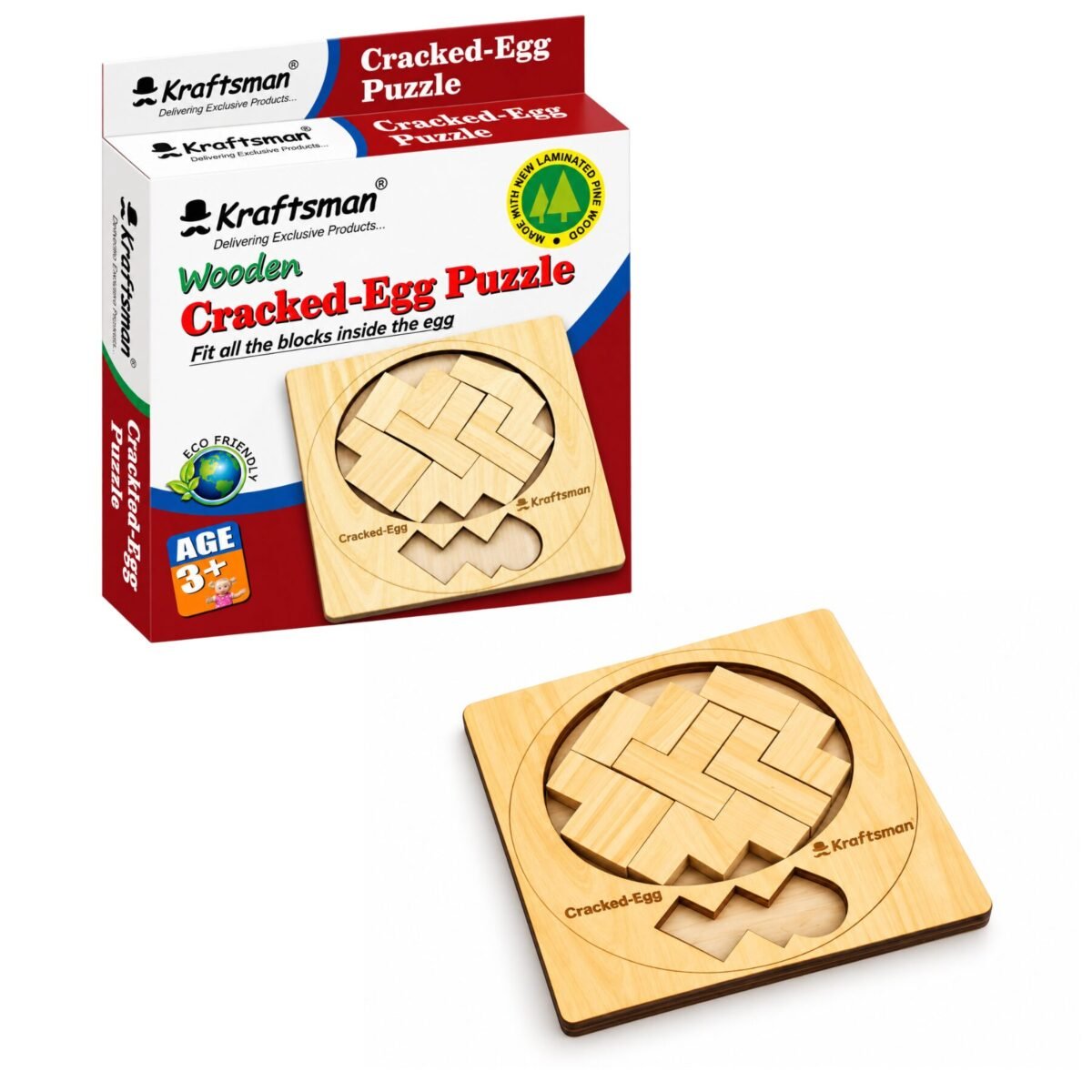
The Cracked Egg Puzzle is exactly what it sounds like: fit all the interlocking pieces back into the egg shape. Because the outline is curved and the pieces are irregular, kids can’t rely on corners to get started. They have to find a different “anchor” piece, and working that out is half the fun.
Best for: kids who like a puzzle with personality. Builds: visual perception and creative problem-solving.
8. Tetris Puzzle (13 Pieces): the real test
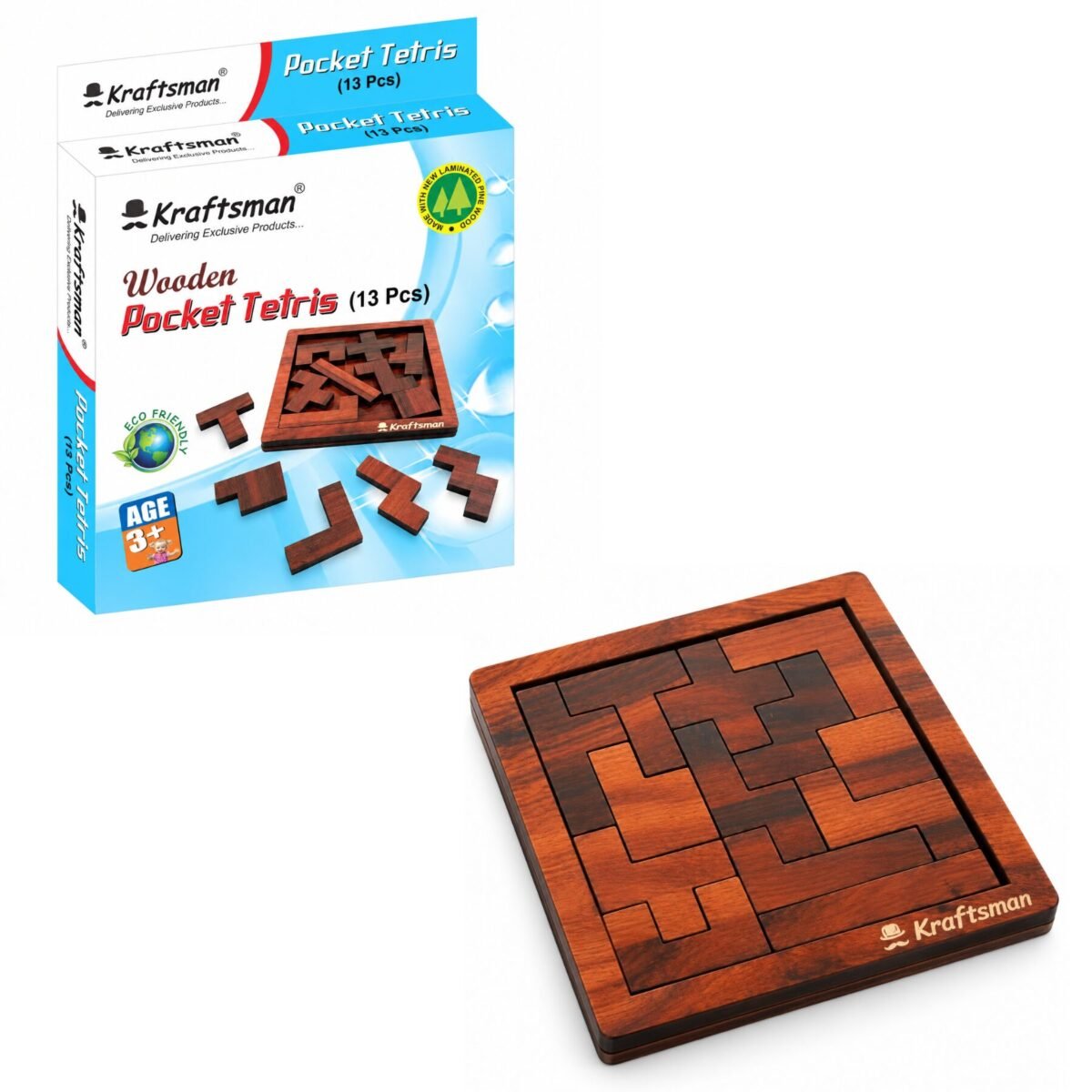
Thirteen pieces in one small square. The Tetris Puzzle (13 Pcs) is the toughest of the tetris family, and it’s where older kids and adults will spend genuine time. Don’t be surprised if it lives on the coffee table for a week while different family members take turns at it.
Best for: ages 10 and up, teens and adults. Builds: planning ahead and sustained focus.
9. 15 Number Slider Puzzle: a 150-year-old craze
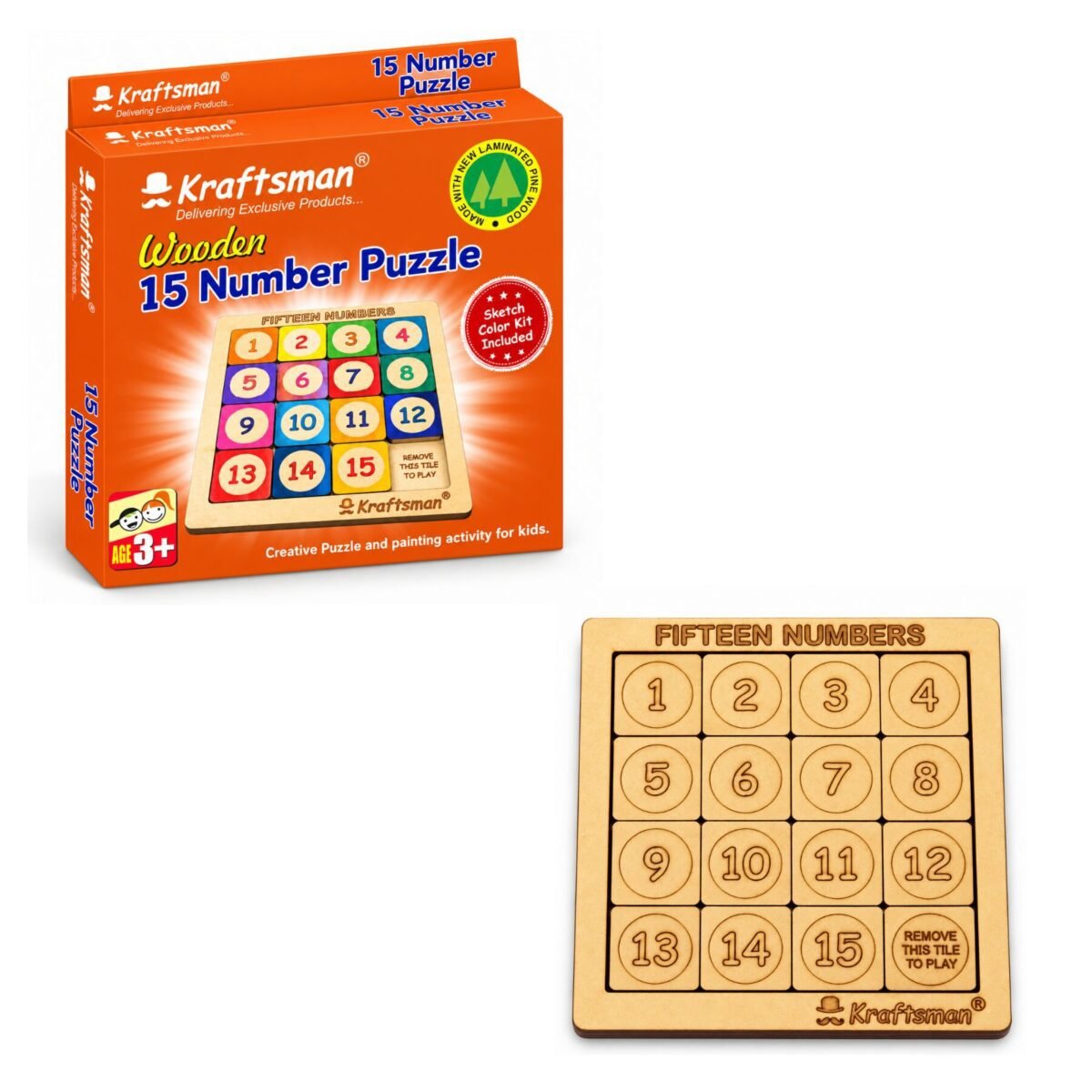
Few puzzles have a story like this one. The sliding “15 puzzle” swept across America and Europe in the 1880s, and people reportedly played it in offices, homes and even on trains. Mathematicians later proved something surprising: if you set the tiles in a random starting position, only half of the possible arrangements can actually be solved.
The 15 Number Puzzle has wooden tiles numbered 1 to 15 and one empty space. Slide the tiles around until the numbers are back in order. It comes with coloring markers, so children can decorate the tiles before they begin, which makes the puzzle feel like theirs.
Best for: ages 6 and up, number lovers. Builds: sequencing, number recognition and planning.
10. Calendar Puzzle: a new challenge every single day
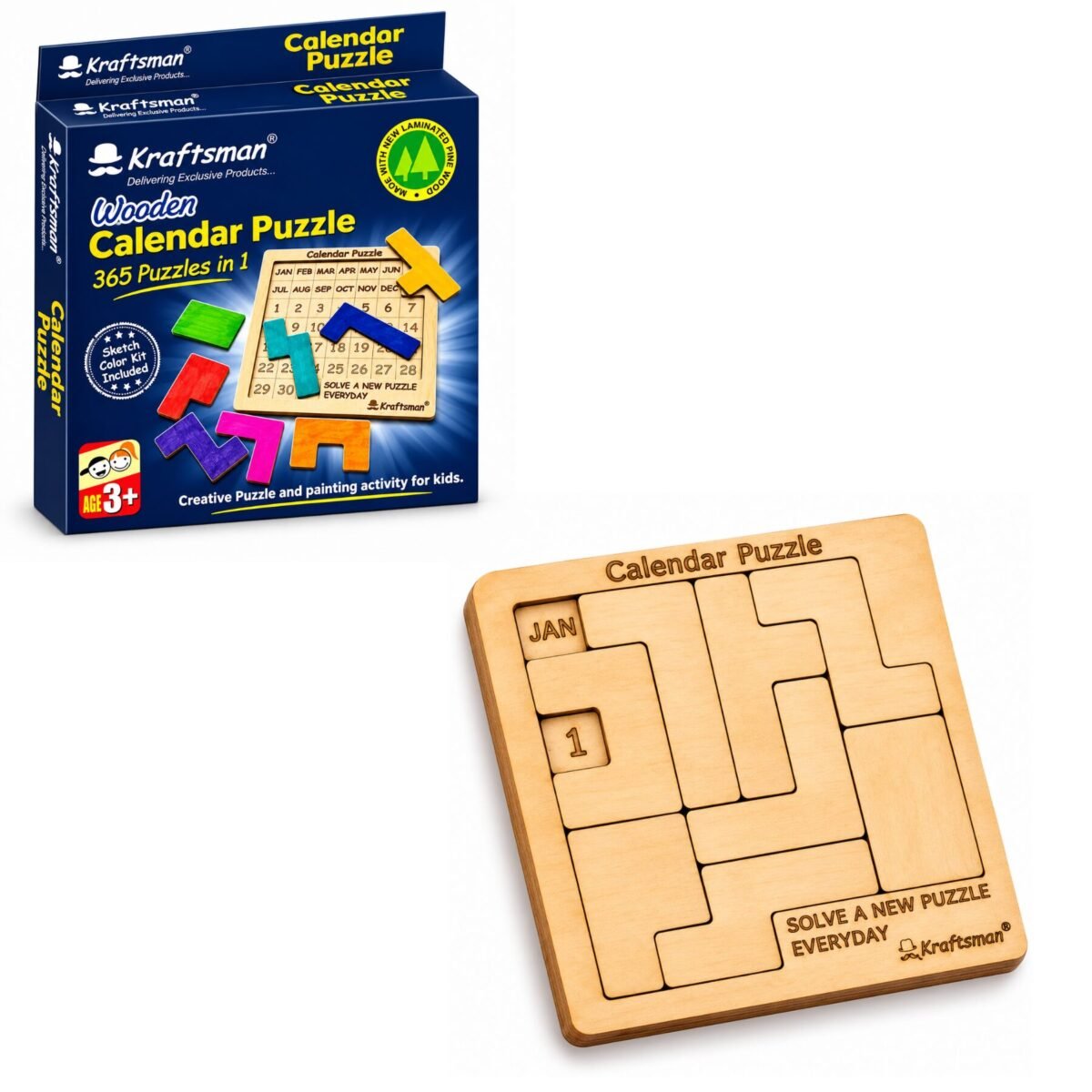
Here’s a puzzle that never runs out. The Calendar Puzzle has a board printed with months and dates, plus six specially shaped wooden pieces. Pick today’s date and fit all six pieces so that only that month and that date stay uncovered. Tomorrow, the challenge changes. That’s 365 different puzzles in one board.
It also makes a wonderful morning habit: solve the date with breakfast before school. Children pick up month names and dates along the way without noticing.
Best for: ages 8 and up, teens and adults, and anyone who likes a daily ritual. Builds: logical thinking and calendar awareness.
How to Choose a Brain Teaser by Age
There’s no strict rule, because children differ a lot. A puzzle-loving six-year-old might happily take on something meant for ten-year-olds. Use this table as a starting point, not a limit.
| Age | Start with | Try next | What to expect |
|---|---|---|---|
| 3–5 years (with an adult) | Tetris 5 Pcs, Tangram (rebuild the square) | Pocket Blocks | Short sessions, lots of help, big smiles when a piece fits |
| 6–7 years | Tetris 5 Pcs, Tangram figures | Tetris 9 Pcs, 15 Number Puzzle | Growing independence, enjoys repeating a solved puzzle |
| 8–10 years | Tetris 9 Pcs, Hexagon, Cracked Egg | Game Ball, Calendar Puzzle | Longer focus, starts planning moves |
| 11 years and up | Game Ball, Tetris 13 Pcs | Calendar Puzzle every day | Genuine challenge, enjoys timing themselves |
| Adults | Tetris 13 Pcs, Calendar Puzzle | The whole set | A calm break from the phone |
A simple tip: if your child gives up within two minutes, the puzzle is too hard for now. Put it away and bring it back in a few months. If they solve it in two minutes and walk away, move up a level. The sweet spot is a puzzle that takes several attempts but still feels possible.
Turning Puzzles Into a Screen-Free Habit
Buying a puzzle is easy. Getting a child to choose it over a cartoon takes a little planning. These routines work well in a lot of homes.
Keep puzzles where screens usually are
If the tablet lives on the sofa, put a puzzle in the sofa basket. Children grab what’s within reach. A puzzle tucked away in a cupboard won’t get played with, however good it is.
The “puzzle before screen” rule
Rather than banning screens, try a gentle swap: fifteen minutes with a puzzle comes first, then screen time. Many kids get so absorbed that they forget to ask for the screen at all. Even when they don’t, they’ve still had fifteen minutes of real thinking.
Make travel time puzzle time
Long car rides, train journeys to the grandparents, waiting at the doctor’s clinic: this is when phones usually come out. Because pocket puzzles come in a pouch and weigh about as much as a small chocolate bar, they slip into a handbag easily. Keep one or two packed and offer them before the phone.
Play alongside them
Children copy what we do. If you sit down with the 13-piece tetris while they work on the 5-piece one, the whole thing feels like family time instead of an assignment. The University of Chicago researchers also noticed that the way parents talk during puzzle play matters. Using words like “turn,” “flip,” “corner” and “edge” helps kids think in shapes.
Turn it into a challenge
Older kids love a stopwatch. Time each solve, write the results on a sheet stuck to the fridge, and see who can beat their personal best by the weekend. Sibling rivalry finally gets put to good use.
Rotate the puzzles
Even the best puzzle gets stale. Keep two or three out and the rest in a box, and swap them every week or two. An “old” puzzle comes back feeling brand new.
Why Wooden Puzzles Instead of Plastic or Apps?
Puzzle apps are not the enemy. Some are well designed, and one study from Swinburne University found that young children could apply puzzle skills they learned on a tablet to the same puzzle in real life. But a physical wooden puzzle offers a few things an app simply can’t.
- No distractions. There are no notifications, ads or “watch next” buttons pulling attention away.
- Real hand skills. Picking up, rotating and placing pieces builds fine motor control that a swipe does not.
- Easy to share. Two people can lean over one puzzle and talk about it. It’s much harder to share a phone screen.
- Built to last. Good wooden puzzles survive being dropped, packed and passed down to a younger sibling.
- Kinder to the planet. Wood is a renewable material, and a toy that lasts for years creates less waste than one that breaks in a month.
Kraftsman Pocket Puzzles: Small Puzzles, Big Thinking
At Kraftsman, we’ve been designing and making wooden toys and games in India since 2019. Our pieces are made by experienced woodworkers from engineered wood, with smooth, rounded edges and non-toxic finishes, because a toy children hold every day has to be safe to hold. The safety certifications our products carry, including BIS and EN71, are listed on our website.
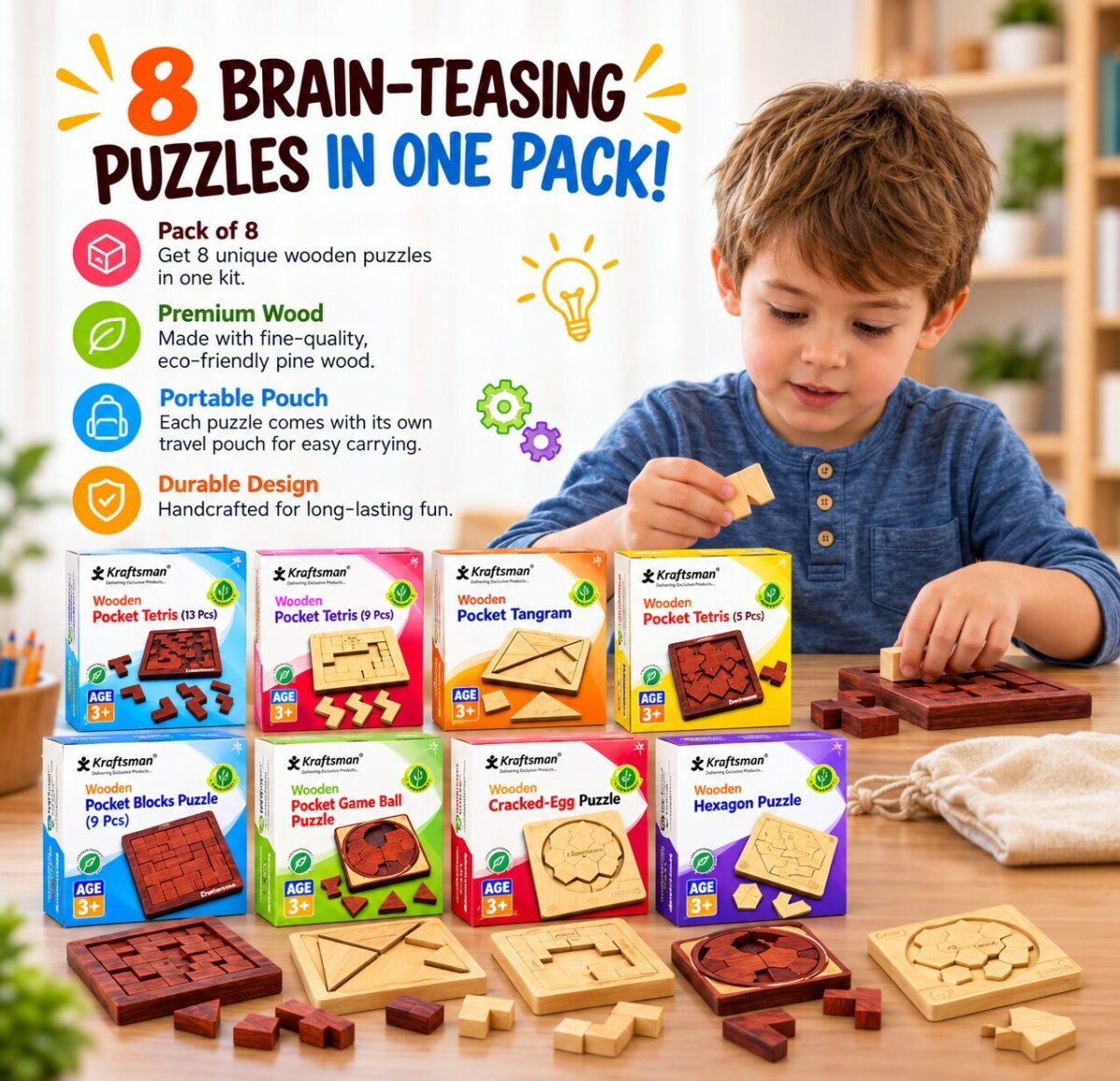
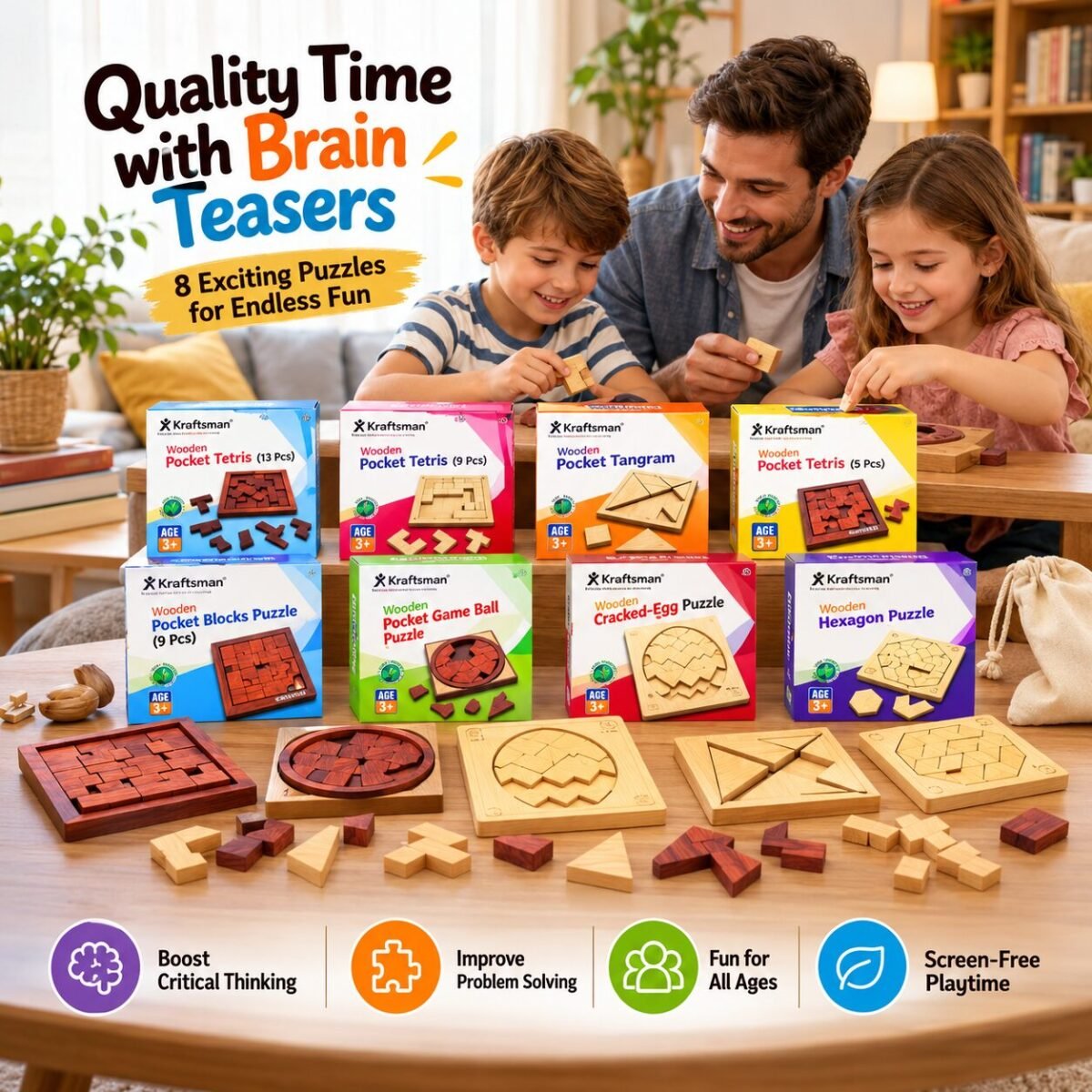
Our pocket puzzle range grew from a simple idea: a brain teaser should be small enough to take anywhere and good enough that you actually want to. If you’d like to try several at once, the Kraftsman Pocket Puzzle Set of 8 brings together eight different pocket challenges in one gift-ready set. It’s a great way for a family to work through a range of difficulty levels together, and it makes a thoughtful birthday or return gift that isn’t another plastic toy.
For a daily habit, add the Calendar Puzzle. For a number lover, the 15 Number Puzzle is a classic that never gets old. You can explore the full range of wooden puzzles, board games and learning toys on the Kraftsman website.
Frequently Asked Questions About Wooden Brain Teaser Puzzles
What age are wooden brain teaser puzzles suitable for?
Simple brain teasers with five or six pieces can be enjoyed from around age three with an adult’s help, and Kraftsman packaging lists its pocket puzzles for ages 3 and up. Independent solving usually starts around six or seven. Harder puzzles, such as a 13-piece tetris or a daily calendar puzzle, suit children aged ten and up, teens and adults. Watch your child rather than the label, and move up when a puzzle becomes too easy.
Are brain teasers good for children’s development?
They can be. Brain teasers give children practice in spatial thinking, planning, patience and coping with small frustrations. A University of Chicago study found that children who played with puzzles between ages two and four showed stronger spatial skills later, though it showed a link rather than a direct cause. The biggest benefit is often the habit of sticking with a problem until it’s solved.
How do brain teasers help reduce screen time?
Brain teasers work because they are genuinely absorbing. They give children something challenging to do with their hands and minds, which makes them a real alternative to a tablet rather than a punishment. Keeping puzzles within reach, offering them before screen time and playing together are the most effective ways to make the swap stick.
What is the difference between a brain teaser and a jigsaw puzzle?
A jigsaw has a picture to match, and every piece has exactly one place. A brain teaser usually has no picture. You get a frame, a set of shapes and a goal, and you have to work out the arrangement yourself, often by rotating and testing pieces. That makes brain teasers more about logic and spatial reasoning than color-and-edge matching.
Are wooden puzzles better than plastic puzzles?
Wooden puzzles are generally more durable, feel more satisfying to handle and are made from a renewable material. They don’t crack easily and can be passed down to younger children. Plastic puzzles are lighter and often cheaper. For a brain teaser that will be carried around and played with often, wood is usually the better long-term choice.
Can adults enjoy wooden brain teaser puzzles too?
Absolutely. Puzzles like the 13-piece tetris, the game ball puzzle and the daily calendar puzzle are genuinely challenging for adults. Many people keep one on their desk for a short break from emails and phones. Solving puzzles alongside your children is also one of the easiest ways to spend screen-free time together.
How do I help my child when they get stuck?
Resist the urge to solve it for them. Ask questions instead: “Which piece looks hardest to place?” or “What if you turned that one around?” Suggest a short break if frustration builds. You can also give one small hint, such as placing a single piece correctly. The goal is for your child to feel that they solved it.
Are wooden brain teasers good for travel?
Yes, especially pocket-sized ones. Kraftsman pocket puzzles measure about 10 × 10 cm, weigh around 100 grams and come with a travel pouch, so they fit easily into a handbag or backpack. They need no batteries or charging, and they make long car rides, train journeys and waiting rooms much easier for children and parents alike.
Do brain teasers make good gifts?
They make excellent gifts because they suit a wide age range, last for years and don’t add to a child’s screen time. A set of puzzles at different difficulty levels works well for birthdays, and single pocket puzzles are a popular choice for return gifts. Choose one slightly above the child’s current level so it stays interesting.
Conclusion
The best part of a brain teaser is the moment it clicks, when a child who was sure it was impossible suddenly sees the answer and looks up, delighted. That feeling of “I figured it out” is worth more than any amount of passive scrolling.
Wooden brain teaser puzzles won’t replace screens entirely, and they don’t need to. What they do is give children a real, absorbing alternative: something to hold, turn and puzzle over. Along the way they practice spatial thinking, patience and planning. Start with an easy puzzle, keep it within reach, play alongside your child when you can, and move up a level when they’re ready.
If you’d like to begin, explore the Kraftsman Pocket Puzzle Set of 8 or pick a single puzzle from the list above. Pack one in your bag this weekend, and see how long it takes before your child asks to try “just one more.”